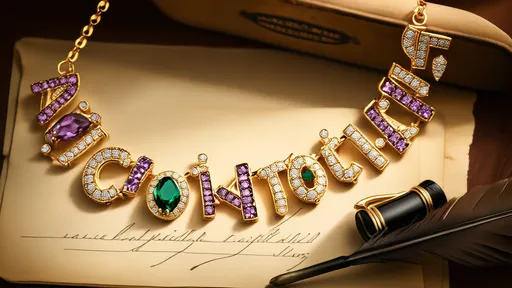
In the hushed drawing rooms of the Victorian era, where courtship was a carefully choreographed dance of subtle glances and veiled meanings, a unique and deeply personal form of jewelry emerged as a silent messenger of the heart. Acrostic jewelry, a brilliant and poetic innovation, transformed precious stones into a secret alphabet, allowing sentiments too intimate for public declaration to be worn proudly, yet discreetly, upon the person. This was not merely adornment; it was a wearable cryptogram, a declaration of love, friendship, or remembrance encoded in the very language of gems.
The foundational principle of acrostic jewelry is elegantly simple: the first letter of each gemstone's name spells out a hidden word or phrase. A bracelet, ring, or brooch becomes a sequence of clues, its true meaning unlocked only by those initiated into its charming cipher. This concept, while perfectly suited to the romantic and sentimental spirit of the 19th century, is believed to have been popularized by none other than Napoleon Bonaparte's jeweler, Marie-Étienne Nitot, the founder of Chaumet. He created pieces for the Empress Joséphine that spelled out affectionate messages, setting a fashionable precedent that would captivate Europe for decades to come.
The Victorians, with their pronounced affinity for symbolism, ritual, and complex social codes, wholeheartedly embraced this trend. In a society governed by strict etiquette, where direct emotional expression was often frowned upon, acrostic jewels offered a perfect solution. They provided a sanctioned outlet for passion and sentimentality, a way to communicate privately in a very public way. A gentleman could present his beloved with a ring that secretly vowed his devotion, or friends could exchange lockets pledging eternal sisterhood, all under the approving—and uncomprehending—gaze of chaperones and society.
To understand the language of these jewels, one must become conversant in the vocabulary of gems. The Victorians operated on a standardized, though not universally rigid, system where each stone corresponded to a letter. Some of the most common pairings included the Ruby for 'R', Emerald for 'E', Garnet for 'G', Amethyst for 'A', and Diamond for 'D'. With this key, a jeweled sequence could be deciphered. A popular and enduring example is the REGARD ring, a classic of the genre. Composed of a Ruby, Emerald, Garnet, Amethyst, Ruby, and Diamond, it spelled out the French word for "esteem" or "affection," a tender and respectful token of love.
Beyond REGARD, a whole lexicon of hidden words was crafted from gemstones. The word DEAREST could be formed from Diamond, Emerald, Amethyst, Ruby, Emerald, Sapphire, and Topaz. Another poignant favorite was SOUVENIR (Sapphire, Opal, Uraninite [or sometimes Pearl for U], Vermeil [a garnet variety], Emerald, Emerald, Jade, Iolite, Ruby), meaning "to remember," often used in mourning or friendship jewelry. The ultimate romantic declaration, AMOUR (Amethyst, Malachite, Opal, Uraninite, Ruby), was a bold and passionate hidden message to wear close to the skin.
The creation of these pieces demanded immense skill and creativity from jewelers. They were not simply stringing beads; they were composing a visual poem where aesthetics and meaning had to harmonize. The primary challenge was that the required stones for a specific word often clashed in color or size. A jeweler's artistry was measured by their ability to arrange potentially discordant gems—a deep red ruby, a vibrant green emerald, a clear diamond, a purple amethyst—into a design that was not only meaningful but also beautiful and cohesive. This often resulted in intricate floral or geometric patterns, scrollwork, and elaborate metal settings that unified the diverse elements into a wearable work of art.
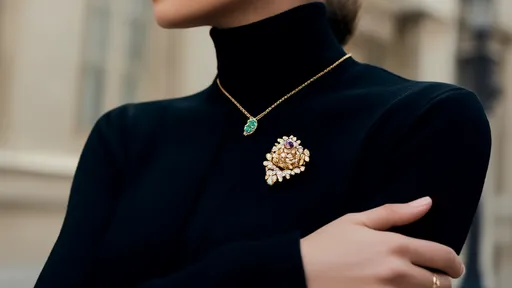
Acrostic messages were crafted into a variety of jewelry forms, each with its own intimate purpose. Rings were perhaps the most personal, often used as engagement or love tokens. Brooches could be displayed prominently on a bodice or lapel, a secret known only to the wearer and a select few. Bracelets, with their larger surface area, allowed for longer words or phrases to be spelled out. Lockets were particularly potent, as they could hold a hidden message on the outside and a keepsake—a lock of hair, a miniature portrait—on the inside, creating a powerful double layer of sentiment.
The decline of acrostic jewelry coincided with the end of the Victorian era. The seismic social shifts brought by the 20th century, including World War I, led to a move away from the elaborate sentimentality and strict social customs of the previous age. Jewelry styles became more abstract, geometric, and overt in their expression. The intricate language of gems was largely forgotten, becoming a curious footnote in the history of adornment. For many decades, these poetic pieces lay dormant in jewelry boxes and museum cases, their once-clear messages rendered inert and mysterious.
However, the 21st century has witnessed a powerful and exciting revival of interest in acrostic jewelry. Modern collectors, historians, and jewelry enthusiasts, armed with research and a growing appreciation for artisanal craftsmanship and historical narrative, have begun to seek out these antique treasures. The thrill of discovery—of uncovering a long-lost sentimental message on a forgotten ring in a flea market—is immense. This resurgence speaks to a renewed desire for personalization and meaning in what we wear. In an age of mass production, a piece of jewelry that tells a unique, century-old story holds incredible allure and value.
Contemporary jewelers, inspired by this historical concept, are now creating modern interpretations of acrostic pieces. While they may use the traditional gemstone alphabet, they often infuse it with personal significance for the client, spelling out names, special dates, or private words of significance. This modern practice honors the romantic spirit of the Victorians while adapting it for today's expressions of love and identity. It proves that the human desire to encode our deepest feelings into beautiful, tangible objects is truly timeless.
Ultimately, Victorian acrostic jewelry represents a breathtaking intersection of art, language, and emotion. It is a testament to a time when love notes were not written on paper but woven into the very fabric of precious stones and gold, to be carried as a constant, secret reminder. These pieces are more than just beautiful antiques; they are frozen poetry, historical artifacts of the heart. They remind us that the most powerful messages are often those not shouted, but whispered in code, waiting for the right person to understand their beautiful, hidden meaning.
By /Aug 27, 2025

By /Aug 27, 2025
By /Aug 27, 2025

By /Aug 27, 2025
By /Aug 27, 2025
By /Aug 27, 2025

By /Aug 27, 2025
By /Aug 27, 2025
By /Aug 27, 2025
By /Aug 27, 2025
By /Aug 27, 2025
By /Aug 27, 2025
By /Aug 27, 2025
By /Aug 27, 2025
By /Aug 27, 2025
By /Aug 27, 2025
By /Aug 27, 2025
By /Aug 27, 2025
By /Aug 27, 2025
By /Aug 27, 2025
