The Art Nouveau movement, which flourished between 1890 and 1910, represented a radical departure from the rigid historicism and industrial aesthetic of the 19th century. In the realm of jewelry, this translated into a breathtakingly new visual language, one that sought to break down the barriers between art and craft, and between the natural world and the wearable object. This was not mere decoration; it was a philosophy worn on the body. At the heart of this philosophy lay a profound and multifaceted obsession with three central motifs: the dragonfly, the female form, and the orchid. These were not arbitrary choices but deeply symbolic elements that together articulated the movement's core ideals of organic beauty, sensuality, and a yearning for a more spiritual, integrated existence.
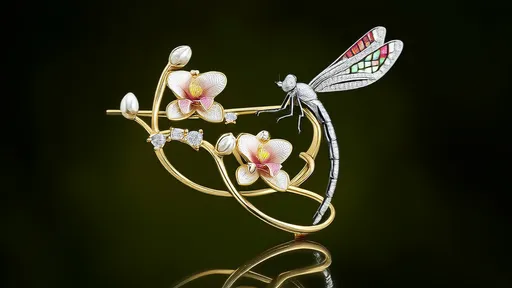
The dragonfly, with its iridescent wings and delicate, engineered form, became an icon of the Art Nouveau jeweler's art. It was the perfect subject to showcase the technical innovations and new materials that defined the era. Masters like René Lalique moved away from the singular emphasis on the monetary value of gemstones and instead celebrated the artistry of the piece itself. They employed plique-à-jour, a fiendishly difficult enameling technique that created stunning stained-glass effects in the wings, allowing light to pass through and illuminate the jewel from within. The dragonfly’s body might be crafted from gold, shaped into sinuous, flowing lines that echoed the tendrils of a vine, and adorned with milky moonstones, fiery opals, or demantoid garnets. But beyond its technical appeal, the dragonfly was rich with symbolism. In many cultures, it represents change, adaptability, and a connection to the dream world. For the Art Nouveau artist, it was a creature of both air and water, a symbol of lightness, transformation, and the unseen forces of nature—a perfect emblem for a movement looking to break free from the heavy, grounded traditions of the past.
If the dragonfly represented the spirit of nature, the female form—invariably depicted with flowing hair, serene and often enigmatic expressions, and bodies merging with natural elements—represented its soul. The Art Nouveau woman was not a portrait of a specific individual but an archetype: a mystical, ethereal being. She was a nymph, a sylph, or an undine—a spirit of the air, forest, or water. This representation was a direct reaction against the stifling social conventions and the oppressive industrialization of the era. She symbolized freedom, mystery, and a primal, untamable natural force. Her long, swirling hair would morph into waves of water or the patterns of wood grain; her gaze was often distant, looking inward or toward some unseen spiritual plane. Jewelers like Georges Fouquet and Lucien Gaillard created breathtaking pieces where the female face, carved in horn or sculpted in gold, emerged from a swirl of enameled foliage and gem-set flowers. This fusion was intentional. It spoke to a worldview where humanity was not separate from nature but an integral part of it. The female form became the ultimate expression of Art Nouveau's ideal: a harmonious, sensual, and deeply spiritual union between the human and the natural world.
Completing this symbolic trinity was the orchid, a flower that captivated the Art Nouveau imagination like no other. Unlike the simple daisy or rose, the orchid is complex, exotic, and often strangely shaped. It is a flower of both breathtaking beauty and subtle peculiarity, making it the perfect subject for a movement that prized originality and the exotic. The orchid’s sensuous, curling petals and labellum offered jeweler’s a fantastic playground of organic, asymmetrical forms to interpret in gold, enamel, and gemstones. Its very nature resonated with the fin-de-siècle mood. It was seen as a rare and luxurious object, a symbol of refinement and the desire for the exotic, often brought back from European colonies. Furthermore, the orchid carried an undeniable undercurrent of eroticism. Its complex reproductive structures and its allure to pollinators made it a natural symbol of sensual pleasure and decadence—themes that were openly explored in the art and literature of the period. In a piece of jewelry, an orchid was never just a flower; it was a statement of sophisticated taste, a hint of the mysterious East, and a celebration of natural, unapologetic beauty.
The interconnection of these three motifs—dragonfly, woman, and orchid—within a single piece of jewelry was where the Art Nouveau philosophy reached its zenith. A seminal work by René Lalique might feature a woman whose hair transforms into the wings of dragonflies, which in turn alight upon the petals of orchids. This was not simply a crowded design; it was a narrative. It told a story of a universe where all life was interconnected, where the spiritual and the sensual coexisted, and where beauty was found in the most intricate and often overlooked details of the natural world. The jewelry became a microcosm of the Art Nouveau worldview.
This profound obsession was, ultimately, a form of escapism and a search for meaning. In the face of rapid urbanization, mechanical reproduction, and social upheaval, artists and intellectuals of the time looked to nature not for realism, but for a higher truth. They sought to capture its essence—its flowing lines, its transformative cycles, its inherent sensuality—and imbue their art with it. The dragonfly, the female form, and the orchid were the most potent vessels for these ideas. They allowed the jeweler to move beyond being a mere craftsman and become a poet, a storyteller, and a philosopher, creating objects that were not just owned but experienced, serving as amulets for a modern age yearning for wonder, beauty, and a reconnection to the natural world.
By /Aug 27, 2025

By /Aug 27, 2025
By /Aug 27, 2025

By /Aug 27, 2025
By /Aug 27, 2025

By /Aug 27, 2025

By /Aug 27, 2025
By /Aug 27, 2025
By /Aug 27, 2025
By /Aug 27, 2025
By /Aug 27, 2025
By /Aug 27, 2025
By /Aug 27, 2025
By /Aug 27, 2025
By /Aug 27, 2025
By /Aug 27, 2025
By /Aug 27, 2025
By /Aug 27, 2025
By /Aug 27, 2025
By /Aug 27, 2025
