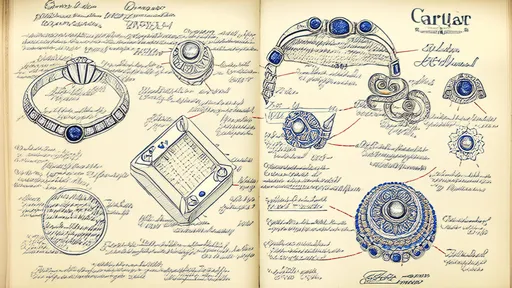
In the hushed halls of auction houses and the private vaults of collectors, a quiet revolution has been unfolding. The spotlight, traditionally reserved for glittering gemstones and masterfully crafted jewels, is increasingly shifting towards something far more humble in appearance yet profound in significance: the original design drawing. Nowhere is this phenomenon more evident than in the growing reverence for the archival drawings of Cartier, a house synonymous with the very pinnacle of luxury and design innovation. These are not mere sketches; they are the sacred blueprints of beauty, the first physical manifestation of a creative vision that would go on to define eras and captivate royalty.
The value of a Cartier design drawing is a complex tapestry woven from threads of art, history, and commerce. To view one is to be granted a privileged audience with the past. Each line, each notation, each subtle watercolour wash tells a story that extends far beyond the eventual object. It is a direct connection to the mind of the designer—a maison’s maison—at the moment of conception. We see the initial spark, the hesitant explorations, the confident final strokes that would guide the hands of master craftsmen. These drawings are the crucial bridge between the abstract world of inspiration and the tangible reality of a finished jewel, making them invaluable documents of the creative process itself.
Furthermore, these archival pieces serve as an impeccable and unassailable historical record. In an industry where provenance is paramount, a Cartier drawing is the ultimate certificate of authenticity. It irrefutably links a jewel to its maker, its date of creation, and its original client. For historians and collectors, this is priceless information. A drawing can reveal which maharaja commissioned a specific ceremonial necklace, which socialite inspired a revolutionary Art Deco bracelet, or how a design was modified to suit the taste of a particular patron. They are the primary sources that allow us to accurately chart the evolution of style, technique, and clientele over the house's storied history.
From an artistic standpoint, these drawings are often breathtaking works of art in their own right. Executed with a precision and skill that is increasingly rare, they showcase a variety of techniques from precise ink line work to delicate gouache and watercolour painting. The artisans who created them were not just draftsmen; they were illustrators of the highest order, capable of rendering the play of light on a faceted gemstone or the lustrous sheen of a pearl with nothing but pigment and paper. The aesthetic appeal of a finely executed jewellery drawing is undeniable, possessing a quiet, intimate beauty that differs from, but complements, the dazzling spectacle of the jewel it represents.
The market dynamics surrounding these works on paper have intensified dramatically. As the jewels they depict become ever more scarce and achieve astronomical prices at auction, the drawings offer a more accessible, though still exclusive, point of entry into the world of collectible Cartier. They represent a form of democratized luxury; not everyone can own a Belle Époque tiara, but a dedicated collector might aspire to own its conception. This demand has created a vibrant secondary market, with significant drawings fetching prices that reflect their esteemed status as both art and artifact. Their value is consistently affirmed in the auction arena, establishing a clear and growing financial appreciation for these paper treasures.
Perhaps the most compelling aspect of the Cartier archive's drawings is their role in preserving institutional memory and ensuring brand legacy. The Cartier Collection, which actively reacquires historic pieces, relies heavily on its own archive to authenticate and understand the jewels it seeks. The drawings are the Rosetta Stone for the house's heritage, allowing modern designers and archivists to decode the techniques, materials, and intentions of their predecessors. This continuous dialogue between past and present ensures that the Cartier of today remains deeply rooted in the values and excellence that defined it for generations, making the archive not a relic, but a living, breathing resource.
In conclusion, the soaring collectible value of Cartier design drawings is a testament to a matured understanding of what truly constitutes value in the realm of high jewellery. It is a recognition that value is not solely inherent in the carat weight of a diamond or the purity of gold, but in the richness of history, the genius of creation, and the authenticity of provenance. These drawings are the soul of the jewel—the permanent, unchanging record of a beautiful idea before it was entrusted to the vulnerability of metal and stone. They are, in every sense, precious.

By /Aug 27, 2025

By /Aug 27, 2025

By /Aug 27, 2025

By /Aug 27, 2025
By /Aug 27, 2025

By /Aug 27, 2025

By /Aug 27, 2025
By /Aug 27, 2025
By /Aug 27, 2025
By /Aug 27, 2025

By /Aug 27, 2025
By /Aug 27, 2025

By /Aug 27, 2025

By /Aug 27, 2025

By /Aug 27, 2025

By /Aug 27, 2025

By /Aug 27, 2025

By /Aug 27, 2025
By /Aug 27, 2025

By /Aug 27, 2025
